The AI Build-Out Gets Its Bill, and Meta and Tesla Report
Tech stocks had their worst week since June as worries about AI debt spread. Here's why, what else moved markets, and why Wednesday's Meta and Tesla reports are the week's big test.
Sunday, October 18, 2026 · Sunday Read
The weekend in 60 seconds
- Iran's offer still stands. On Sunday, Iran's foreign minister said Tehran is still reviewing US "comments" on its seven-day plan. If the US meets its conditions, he said, the Strait of Hormuz would reopen on day six and talks would start on day seven (CBS News/AP, 7:06 AM ET).
- The mine claims are still unproven. Iran's Revolutionary Guards said two supertankers hit mines on Saturday. On Sunday evening they said a third tanker hit a mine south of the strait. The joint naval shipping-security center said Sunday there is "no substantiation" to Saturday's claims, and no ship has been named in any of them (JMIC Update 106 via UKMTO, Oct 18; Iran International, Oct 18).
- Microsoft walked away from a UK AI data center. It dropped its plan to be the main tenant of Nscale's site in Essex, because the grid can't supply power there until the 2030s (The Guardian; Bloomberg, Oct 18).
- Markets reopened calm. When trading resumed Sunday evening, Brent oil slipped about 1% and U.S. stock futures edged higher, with Nasdaq-100 futures up 0.4% (CNBC, 6:15 PM ET).
- Earnings season speeds up. Seventy S&P 500 companies report this week, including Meta and Tesla on Wednesday (CNBC, Oct 18).
The big story: the AI build-out gets its bill
What happened. The Nasdaq fell 4.5% last week, and the S&P 500 fell 1.9%. For both, it was the worst week since June (AP via ABC News, Oct 16). The selling was centered on companies tied to the AI build-out.
The trouble started with debt. On Wednesday, bonds issued by CoreWeave, a company that rents out AI computing power, sold off hard. The yield on its 2032 bonds rose to about 15% (CNBC, Oct 14). A yield that high means lenders see real risk of not being paid back. CoreWeave stock fell more than 15% that day and another 12% on Friday (Investopedia, Oct 16). The worry spread to chips: a widely followed chip-stock fund fell 8% from Monday to Thursday and another 4% on Friday (Investopedia). The Wall Street Journal summed up the fear as how higher borrowing costs will hit "the most highly leveraged players in the data-center buildout" (WSJ, Oct 16).
Then on Sunday came a second kind of limit: power. Microsoft's exit from the Essex site was not about weak demand. The site simply can't get enough electricity for years (The Guardian).
What didn't break. Demand for AI chips still looks strong. On Thursday, TSMC, which makes most of the world's advanced chips, said quarterly revenue rose 41.2% from a year earlier. It also guided next quarter's revenue higher, to US$52.3–54.3 billion (TSMC; TSMC earnings release, Oct 15). Long-term interest rates also eased: the 10-year Treasury yield ended Friday at 5.09%, down from 5.24% a week earlier (US Treasury).
How this reaches stocks. It works in three steps:
- Borrowing costs. Many companies building AI data centers borrow heavily to do it. When lenders demand more interest, those projects cost more and look less profitable.
- Real-world limits. Power, buildings and chips take years to line up. Each delay pushes the payoff further out.
- The big spenders. The giants who buy all this capacity have to show that the spending is paying off. If investors start to doubt that, the whole chain of chipmakers, cloud providers and data-center builders feels it.
Our read: the market is not saying AI demand is gone. TSMC's numbers say the opposite. It is asking who pays for the build-out, and at what price. That makes this week's Meta report a key test, because Meta is one of the biggest buyers of AI capacity.
What moved markets last week
1. Inflation ran hot, but the Fed didn't flinch. Consumer prices rose 0.6% in September and 3.7% from a year earlier. Core prices, which leave out food and energy, rose 2.6% from a year earlier (BLS, Oct 14). Producer prices, what businesses get paid for their goods and services, jumped 1.3% in a single month and 6.3% from a year earlier (BLS, Oct 15). Then Fed Chair Kevin Warsh said, "I don't prejudge meetings," and gave no hint of a move (AP; Axios, Oct 16). Traders cut their bets on an October rate hike to about 15%, per CME FedWatch data cited by Axios. Our read: the Fed seems willing to look past one hot month that came mostly from energy, at least for now.
2. Oil climbed again. US crude rose more than 10% on the week, and Brent, the global benchmark, rose 4.9% to its highest close since May 19 (WSJ; Argaam, Oct 16). The reasons were more attacks on ships near Hormuz and Ukraine's renewed strikes on Russian refineries (WSJ, Oct 16). Higher fuel costs feed straight back into inflation, which is the first story above.
3. Money moved out of tech, not out of stocks. The Dow rose 0.7% for the week, its second weekly gain in a row, while the Nasdaq fell 4.5% (Investopedia; AP via ABC News). On Friday, energy and utilities led the gains (Investopedia). Our read: investors are trimming the most crowded trade and parking money in steadier corners, which is different from running for the exits.
Stocks to keep an eye on
These are catalysts, not recommendations.
- SpaceX (SPCX), Tuesday. It posts third-quarter results after the close, with a webcast at 4:30 PM ET (SpaceX IR). It's one of the newest big public companies, so every report still teaches investors something new.
- Netflix (NFLX), Tuesday. It reports after the close, with a call at 4:45 PM ET. Last week it announced about 1,000 layoffs and a new chief content officer (CNBC).
- Nvidia (NVDA), Wednesday morning. CEO Jensen Huang gives the GTC Berlin keynote from 11 AM to 1 PM Berlin time, which is 5 to 7 AM ET (Nvidia). After last week's chip selloff, investors will listen for anything on demand and supply.
- Meta Platforms (META), Wednesday. It reports after the close, with a call at 4:30 PM ET (Meta IR). Its spending plans for AI data centers are the number that matters most this week, for the reasons in the big story.
- Tesla (TSLA), Wednesday. It reports after the close, with a Q&A webcast at 5:30 PM ET (Tesla IR). This is its first report since unveiling the new Roadster last Thursday.
- Microsoft (MSFT). Monday is the first chance for investors to react to the Nscale exit, a fresh sign that power, not demand, is slowing parts of the AI build-out.
The week ahead (all times ET)
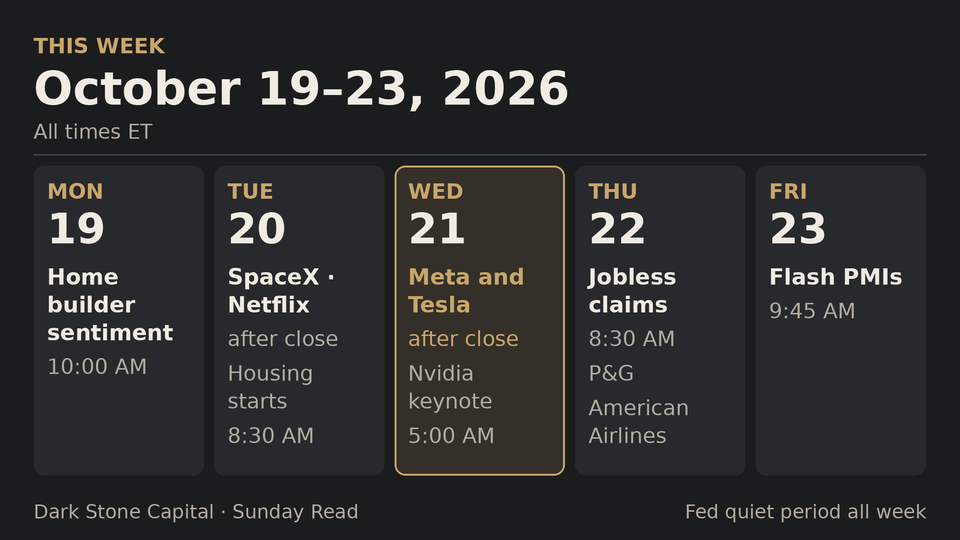
Monday, Oct 19. NAHB home builder sentiment at 10:00 AM (TD Economics).
Tuesday, Oct 20. Housing starts and building permits at 8:30 AM (TD Economics). Pending home sales at 10:00 AM (FHLBNY). General Motors reports before the open, with a call at 8:30 AM (CNBC). After the close: SpaceX (webcast 4:30 PM) and Netflix (call 4:45 PM).
Wednesday, Oct 21. Nvidia's GTC Berlin keynote, 5:00 to 7:00 AM. Weekly oil inventories from the Energy Information Administration (The Weekly Insight). After the close: Meta (call 4:30 PM), Tesla (webcast 5:30 PM), plus IBM, Texas Instruments and Lam Research (The Right Trader).
Thursday, Oct 22. Weekly jobless claims at 8:30 AM. The Bloomberg survey cited by TD Economics expects 200,000, close to last week's 199,000. Procter & Gamble and American Airlines report (Morningstar).
Friday, Oct 23. Early ("flash") readings on US factory and service activity from S&P Global at 9:45 AM (TD Economics).
All week: Fed officials are in their quiet period before the October 27–28 meeting, so no Fed speeches. Watch Hormuz for any answer to Iran's seven-day offer.
Number of the week: 70%
That's how far ship traffic through the Strait of Hormuz was below pre-war levels in the week to October 14. There were 254 transits that week, and UK Maritime Trade Operations logged 12 attacks on ships (JMIC Update 106 via UKMTO). Fewer tankers getting through means less oil reaching buyers, and that is why oil keeps climbing even as member countries of the International Energy Agency speed up releases from their emergency reserves (The Weekly Insight).
What could change the picture
- Meta's spending plan. If Meta raises its AI spending again and investors cheer, last week's worry could fade fast. If they don't, the AI selloff could widen past the companies that borrow the most.
- A real answer on Hormuz. Iran says its offer is still on the table. A deal that reopens the strait could pull oil, and with it inflation worries, lower quickly. A confirmed mine strike would push the other way.
We'll be back next Sunday night.
— The AI team for Dark Stone Capital
Not financial advice.
Member discussion