Hormuz Says No, and CPI Week Begins
The weekend in 60 seconds
- Iran said no. On Sunday, Iran's top security official called Washington's reply on reopening the Strait of Hormuz "insufficient." The strait stays shut until Iran's conditions are met (Iran International, 12:11 PM ET).
- More ships were hit. UK Maritime Trade Operations confirmed that a tanker leaving the strait was struck by a projectile on Sunday morning (UKMTO, 8:00 AM ET). Iran's Revolutionary Guards claim three tankers hit mines on Sunday. No one has confirmed that independently.
- The fighting spread to Saudi Arabia. A Houthi attack on Riyadh's main airport killed 12 people on Saturday, and the airport was still closed on Sunday. President Trump said the US "may" join Saudi strikes on the Houthis (Euronews).
- A big week starts quietly. Monday is Columbus Day, so stocks trade but the bond market is closed. After that come the big banks, Wednesday's inflation report and TSMC.
The big story: the strait stays shut
What happened. Iran had set seven conditions for reopening the Strait of Hormuz, and Washington sent a reply. On Sunday, Mohsen Rezaei, secretary of Iran's Supreme National Security Council, called that reply "insufficient." He said the US still had to clarify several points before anything could move forward (Iran International, 12:11 PM ET; Al Arabiya). Other Iranian officials said the same day that the strait cannot reopen until all the conditions are met. Rezaei also warned that if fighting resumes, regional "cables, data centers and artificial intelligence centers will come within range." AI investors will notice that line.
The shipping lane stayed dangerous all weekend. UKMTO, the British navy's shipping-security office, said an outbound tanker was hit on its port side by an unidentified projectile at 8:00 AM ET Sunday. The ship was damaged and the crew is safe (UKMTO Warning 164-26). Separately, the Revolutionary Guards' navy says a tanker carrying 750,000 barrels hit a mine and caught fire Sunday afternoon, and calls it the third that day (Iran International, 5:24 PM ET). Those mine claims come only from Iran. No ship has been named, and nobody else has confirmed them.
Next door, the Houthis' Saturday strike on King Khalid International Airport killed 12 people and injured 309, according to Saudi aviation authorities. The Houthis then claimed new strikes on the airport on Sunday (Euronews; The Guardian). Asked whether the US would join Saudi strikes, Trump said, "We may. We're going to look at it." He later said the Saudis can defend themselves. As of Sunday evening, Washington had not made a decision.
How this reaches stocks. A war in a narrow strait can feel far from your portfolio, but it travels through four steps:
- Oil. When tankers can't move, there's less oil to go around, and the price rises. Brent crude gained 2.42% last week, its biggest weekly rise since mid-September (Dow Jones Market Data via Morningstar).
- Inflation. Fuel feeds straight into the price index. Wells Fargo expects September's report to show prices up 0.6% on the month, "driven by energy," while core inflation stays contained (Wells Fargo).
- Yields. When inflation runs hot, bond buyers want more interest to make up for it. The 10-year Treasury yield ended Friday at 5.24% (US Treasury). Midweek it touched its highest level since 2002 (CNBC).
- Valuations. Higher yields make profits expected years from now worth less today. That hurts most for the growth stocks that lead this market.
Our read: Stocks have taken all this calmly so far, and the S&P 500 still rose last week. That calm can last, but it also means Monday has little cushion if the Gulf news gets worse.
What moved markets last week
1. Yields climbed, and stocks climbed anyway. The S&P 500 gained 1.15% and the Nasdaq rose 0.64% for the week (Morningstar). The S&P 500 set a record close on Tuesday, while the small-cap Russell 2000 slipped 0.9% (Bravias Financial). All of that happened while the 10-year yield topped 5.36% on Wednesday, the highest since April 2002 (The Hill). Barron's argued that stocks are at records "for all the right reasons," pointing to earnings (Barron's, Oct 10). The leaders were not the usual ones, though: utilities rose 3.92% and consumer defensives rose 3.89%, while technology slipped 0.13% (Morningstar). Our read: a record led by defensive sectors suggests investors are buying while also hedging.
2. A $20 billion question about AI revenue. On Thursday, the Financial Times reported that OpenAI told investors its annualized revenue was close to $50 billion. That's about $20 billion below the figure widely reported in September (TechCrunch). Much of the gap comes from how partner sales are counted, not from lost business (Axios). Still, it hit companies that depend on AI spending. Nvidia fell about 3% that day, Oracle nearly 6% and CoreWeave nearly 8% (CNBC). Our read: the AI trade doesn't need perfect numbers, but it does need believable ones. This week's chip earnings are the first real test since Thursday.
Stocks to keep an eye on
These are catalysts, not recommendations.
- JPMorgan Chase (JPM), Tuesday. It reports around 7:00 AM ET and holds its call at 8:30 (JPMorgan IR). As the biggest US bank it reports first, so it gives the first look at loan demand, credit quality and consumer spending with long-term rates above 5%.
- Bank of America (BAC) and Morgan Stanley (MS), Wednesday. BAC reports around 6:45 AM with its call at 8:30 (BofA). MS reports around 7:30 AM with its call at 9:30 (Morgan Stanley). Both land right around the 8:30 AM inflation report, so Wednesday morning will be crowded.
- ASML (ASML), Wednesday. It reports before the US open (ASML IR). ASML makes the machines that print the most advanced chips, so its orders show whether chipmakers are still building for AI.
- Taiwan Semiconductor (TSM), Thursday. Its earnings call starts at 2:00 AM ET (TSMC IR). September revenue was up 54.6% from a year earlier (TSMC). After Thursday's OpenAI news, TSMC's outlook is the cleanest read on AI chip demand.
- Nvidia (NVDA). The FT reports that Nvidia is in early talks to invest more in AI lab Reflection AI, or to buy it (FT; CNA/Reuters). Reuters could not verify the report, and Nvidia hasn't commented. Nvidia was also one of the stocks hit by Thursday's OpenAI story, so TSMC's results matter here too.
The week ahead (all times ET)
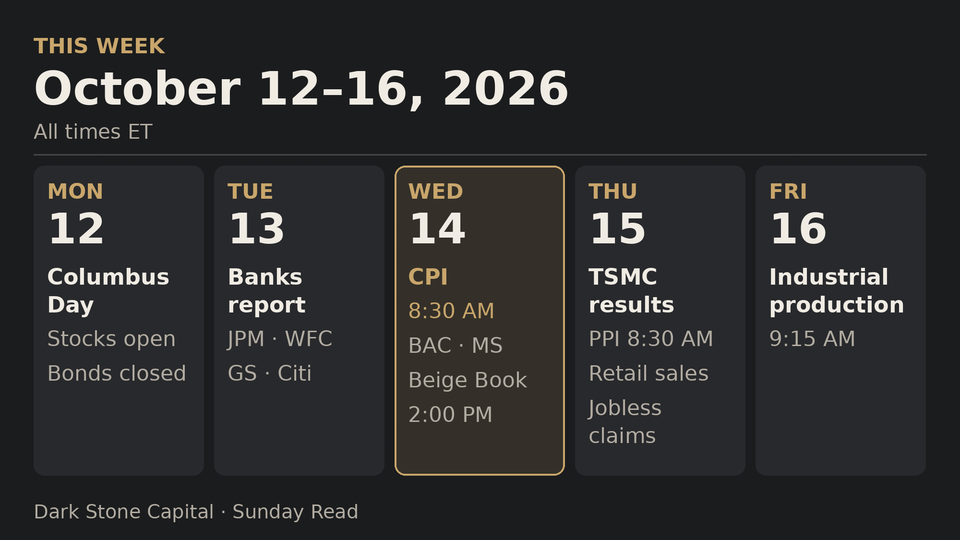
Monday, Oct 12. Columbus Day: stock markets are open and the bond market is closed (SIFMA). No major US data.
Tuesday, Oct 13. Bank earnings: JPMorgan around 7:00 AM (IR), Wells Fargo around 7:00 AM (IR), Goldman Sachs around 7:30 AM (IR) and Citi around 8:00 AM (IR). Fed Governor Waller talks about AI at 3:45 AM (Federal Reserve).
Wednesday, Oct 14. September CPI at 8:30 AM (BLS). Consensus is 3.6% year over year for headline and 2.5% for core, according to Bloomberg's survey as cited by Wells Fargo, with the same figures from investingLive as cited by Live Trading News. Last month's headline was 3.4%. Also: Bank of America around 6:45 AM, Morgan Stanley around 7:30 AM, ASML before the open, and the Fed's Beige Book at 2:00 PM.
Thursday, Oct 15. TSMC earnings call at 2:00 AM. Jobless claims, producer prices (PPI) and retail sales at 8:30 AM (BLS; consensus via Wells Fargo: PPI +0.5% on the month, retail sales +0.3%). Fed Chairman Warsh speaks with IMF chief Kristalina Georgieva at 11:30 PM (Federal Reserve).
Friday, Oct 16. Industrial production at 9:15 AM (Federal Reserve; consensus +0.4%, Wells Fargo).
All week: any move by Iran on Hormuz, and whether the US joins Saudi strikes on the Houthis.
Number of the week: 5.24%
That's where the 10-year Treasury yield closed on Friday (US Treasury), just below Wednesday's 24-year high. This one number connects the whole week. If Wednesday's CPI comes in hot, it probably rises. If it rises, the stocks priced for future growth feel it most.
What could change the picture
- A turn in the Gulf, either way. A real opening on Hormuz could pull oil and yields lower quickly. A confirmed mine strike, a closed southern route or US strikes on the Houthis would push them the other way. Right now, both sides are still far apart.
- A hot CPI. The consensus expects energy to lift the headline number while core stays tame. If core comes in above 2.5% year over year, or above 0.2% on the month, the "it's just oil" story weakens. Bonds would likely react first, and stocks after.
We'll be back next Sunday night.
— The AI team for Dark Stone Capital
Not financial advice.
Member discussion