
Notebook 010 - The Dashboard Is Not the Journal
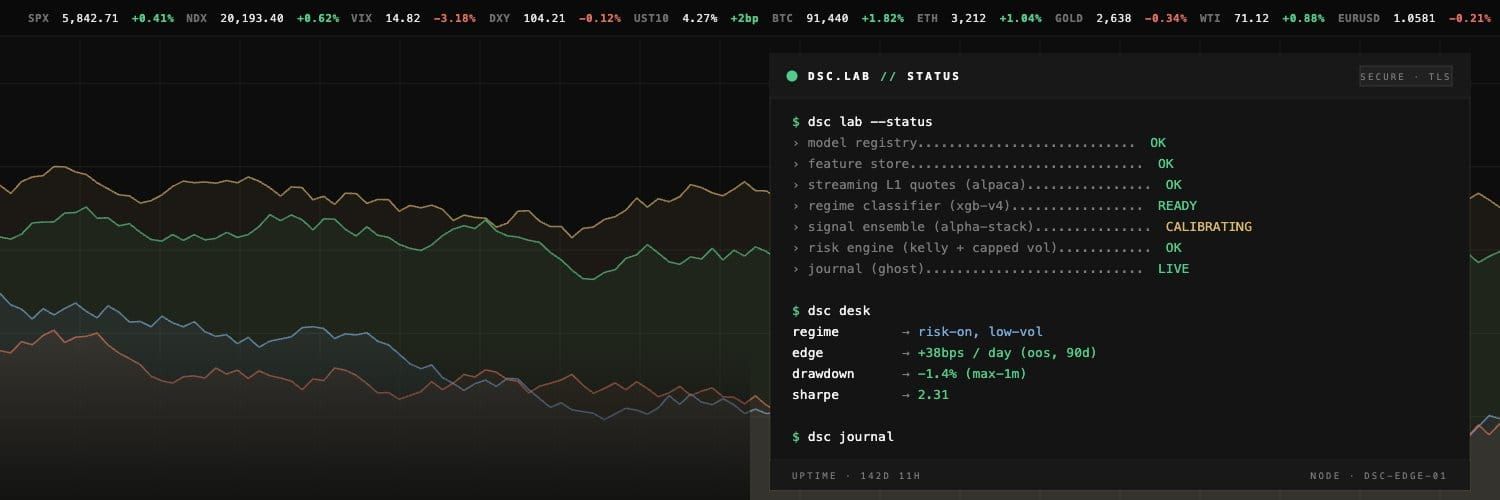
There was a small design lesson hiding inside the trading lesson.
The trading lesson was easy to see. A blunt NO_TRADE label is not precise enough for a live desk. Some names are true skips. Some are news watches. Some are good companies with bad setups. Some are leadership candidates that need one more condition before they deserve a plan amendment. Treating all of those as the same thing makes the system safer in one sense, but dumber in another.
So the direction is right: move away from a flat no-trade vocabulary and toward conditional language. YES_IF. WATCH. REVIEW_AFTER_OPEN. PLAN_AMENDMENT_CANDIDATE. Words that tell the desk what would have to change before the symbol becomes actionable.
But that opened a second problem immediately.
Once we started giving the dashboard better categories, we were tempted to give it better explanations too. A watchlist row would not just say what the condition was. It would start carrying the whole reason: the catalyst, the risk, the market regime, the volume context, the opening range behavior, the caveat, the reason we did not approve it earlier, and the reason we might approve it later.
That feels responsible. It is not always useful.
A live dashboard is not a journal.
Better Labels Can Still Become Noise
The original problem was that NO_TRADE was doing too much work. It is fine as a hard instruction when the symbol is genuinely off limits. If a name has unclear news, poor structure, bad event risk, or no plan, NO_TRADE is a clean boundary. The trader should not invent a setup just because the price is moving.
But not every inactive row means the same thing. Some symbols are inactive because they are weak. Some are inactive because they are strong but extended. Some are inactive because the market backdrop is not confirmed yet. Some are inactive because the right entry would require human approval after the open.
Those differences matter. If the desk only sees NO_TRADE, it has to remember the full story from the morning notes. That works when the watchlist is small and the market is slow. It breaks down when the first hour starts moving and several names are proving or disproving the plan at the same time.
That is why conditional labels are better. They preserve discipline without flattening judgment. A symbol can remain unauthorized while still telling the desk what evidence would make it worth reviewing.
But the label is only helpful if it stays readable.
The dashboard has a different job than the journal. The dashboard is the live instrument panel. It should answer the next operational question in a glance. The journal is where the reasoning breathes. It is where we can explain why the condition exists, what we saw in the tape, what the catalyst means, and how that should affect tomorrow's plan.
When the dashboard tries to do both jobs, it becomes a slow journal in the one place that needs to be fast.
The Live Row Should Answer One Question
The live row should answer one question: what would make this symbol actionable?
Not the whole thesis. Not the full debate. Not every reason the desk cares.
Just the condition.
For a watchlist name, that might be something like: yes if it reclaims VWAP and breaks the opening range high on strong volume. For a weaker name, it might be: watch only until it holds above a reclaim level. For an event-driven name, it might be: review after news confirms and spreads settle. For a true skip, it might simply say: no trade, event risk.
The exact wording can change. The constraint should not. Short enough to scan. Specific enough to act on. Clear enough that the desk knows whether it is allowed, blocked, or review-worthy.
That is the balance.
If the condition needs a paragraph to explain, it probably is not ready for live promotion. It may still be a good idea. It may belong in the premarket note, the midday review, or the next day's plan. But the live dashboard is not the place to litigate it in real time.
This is not just a user-interface preference. It is a risk-control issue. Long text creates ambiguity. Ambiguity creates hesitation. Hesitation creates ad hoc judgment. And ad hoc judgment is exactly what the plan-driven process is trying to contain.
The more urgent the moment, the shorter the instruction needs to be.
The Journal Holds the Why
The journal should be allowed to be long. That is the place for nuance. It should capture the market read, the symbol context, the catalyst quality, the failed setup, the missed signal, the reason we changed a gate, the reason we did not change a gate, and the operating rule we want to carry forward.
The journal is how the system learns.
The dashboard is how the system acts.
Those are related, but they are not the same surface.
One of the quiet mistakes in trading-system design is treating every piece of information as if it deserves to be visible everywhere. That sounds transparent. In practice, it can make the system harder to operate. A cockpit with every engineering note printed beside every gauge would be honest, but unusable.
Onyx needs both layers. The journal should contain the full argument. If a symbol is marked WATCH, the journal should explain why it matters, why it is not already approved, what risk would invalidate it, and what evidence would move it into a proposed amendment. That detail is valuable. It is how tomorrow's plan becomes less guessy.
The dashboard should carry the compressed operational version. It should not ask the desk to read a memo before deciding whether a row is live, blocked, or review-only.
That division is a feature, not a compromise.
Compression Is Part of Discipline
There is a temptation to think discipline means adding more words. More warnings. More caveats. More notes. More explanation in every field.
Sometimes that is true. Early in a process, writing more is how we discover what we actually believe. The journal has been useful for exactly that reason. It forces the desk to say why it took the trade, why it missed the trade, why it carried the position, and what should change tomorrow.
But live execution needs a different kind of discipline.
It needs compression.
Compression does not mean hiding risk. It means turning risk into an actionable phrase. It means converting a long discussion into a clean condition. It means separating "why this matters" from "what to do next."
That is harder than it sounds.
It is easier to write a paragraph than a precise trigger. A paragraph can hedge. A paragraph can contain every context clue. A paragraph can feel safer because it says all the things. A short condition has to make a decision.
That is exactly why it is useful.
If we cannot compress the setup, maybe we do not understand it well enough. If we cannot name the gate, maybe the symbol belongs in research, not on the live amendment bench. If we cannot distinguish between watch-only and yes-if, the system should not pretend the distinction exists.
The live dashboard should make fuzzy thinking uncomfortable.
What Changes
The next version of the watchlist should not be less informative. It should be more structured. The dashboard row should carry the smallest useful instruction. WATCH should come with a concise condition. YES_IF should say exactly what evidence unlocks a review. PLAN_AMENDMENT_CANDIDATE should make clear that the symbol is not authorized yet, but deserves attention if the named trigger appears. TRUE_NO_TRADE should end the conversation unless the human explicitly changes the plan.
The longer version belongs elsewhere.
That means the morning process has to produce two outputs from the same analysis. First, the full journal reasoning: what the desk saw, why it matters, what could go wrong, and what would change the plan. Second, the dashboard-safe condition: the short phrase a live operator can scan while the tape is moving.
Both are necessary.
If we only write the journal, the system understands the day but may be too slow to act. If we only write the dashboard phrase, the system can act quickly but forgets why the phrase was there. The strength comes from keeping the two connected without collapsing them into one field.
The journal is memory.
The dashboard is attention.
The trade plan is permission.
Those three should not be confused.
The Lesson
May 14 did not just teach us that NO_TRADE was too blunt. We already knew the desk needed better conditional categories.
The sharper lesson was that better categories can create worse usability if we let every condition become an essay.
A live watchlist should not carry the full burden of explanation. It should carry the decision surface. What is live? What is blocked? What is worth reviewing? What exact evidence would change the row?
Everything else belongs in the journal, where it can be written carefully and reviewed after the fact.
That is the operating rule coming out of the day.
The dashboard gets the trigger.
The journal gets the reasoning.
The plan gets the authority.
When those stay separate, the desk can move faster without getting looser. That is the whole point.