
Notebook 029 — How Dark Stone Capital Uses AI to Run the Desk
What we are trying to improve
Dark Stone Capital is a systematic shop. We trade our own capital. The work that matters is not finding a new opinion every morning. It is writing a plan, then following only the parts of the tape that match it.
That is harder than it sounds. A session produces constant invitations to guess. A name that was not on the map starts to move. A name that was on the map never tags. The index is mixed. Someone wants a decision so the day feels used. If the person running the desk answers those invitations, the plan becomes a suggestion.
We use Grok Bot, and a dashboard we built for this company, to keep the plan in charge. The AI is not there to pick winners. It is there to keep emotion and improvisation out of the window where money can be touched.
The rule the whole desk is built around
The sequence is fixed.
The plan is written before the open. Each name gets a read: hold, lost-line, spent, or pass. Side is not forced in that read. The tape, once cash is open, picks the side. The map picks the line. A trade is only a trade if price comes to that plan and the requirements are still intact: where we are wrong, where it pays, and a reason that was written when we were not in the middle of the tape.
If price never comes to the plan, we do not invent a new one. If price is already through the plan, we do not chase it and call that “the market came to us.” If a name is spent, the long map is used up. That is not a short. Short is only when last is under the lost-line and the tape is actually short. If a name is on stand-down or hold-fire, it stays there.
Sit is a complete call. Most names, on most days, will not meet the map. A quiet book is not a failure of the process. It is the process working.
That rule is older than the bots. The bots exist so we do not abandon it at 10:14.
The dashboard we built
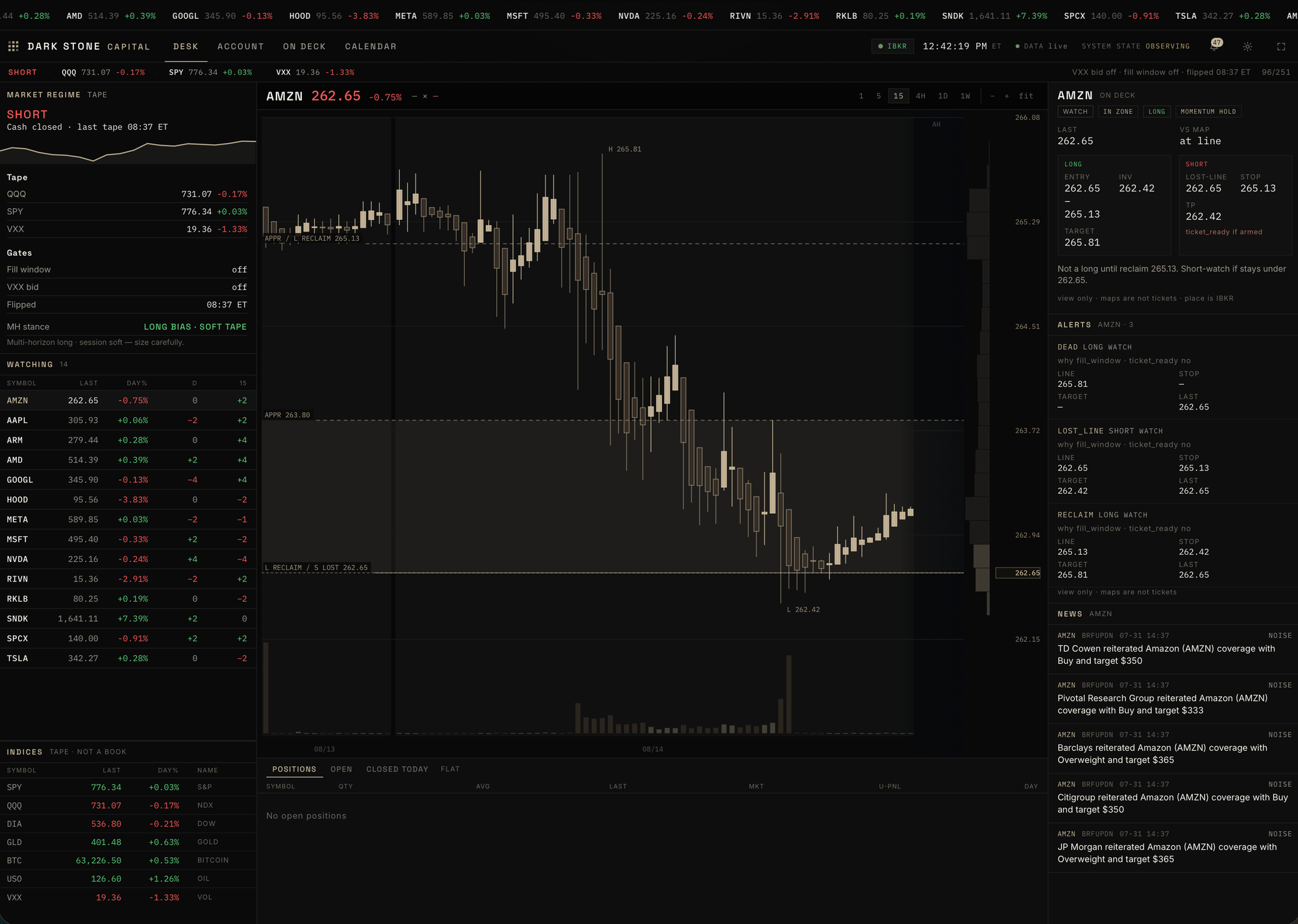
A plan you cannot see in one place will not survive a session. We built our own desk for that reason. It is the company board: account, tape, On Deck, calendar, and a chart we control.
The Officer is supposed to read the truth in a glance. Last is defined by us. While regular hours are open, last is the tape. When cash is shut, last is the official regular-hours close. On a weekend, last is Friday’s cash close. After-hours leftovers do not replace that print. Bitcoin is the exception because it trades around the clock, so its last does too.
On Deck holds maps. A map is research. It is not a ticket. The ticket rail on the board is view-only. Placement stays with the broker. Index and volatility names sit on the board as context, not as ideas. Clip is exposure. It is not risk. The board can show a dollar figure and an R figure next to a map. A green dollar figure is not permission to trade.
We built this so every role, human or AI, argues from the same last and the same plan. If those two things drift, the desk starts guessing again.
How Grok Bot is actually used
Grok Bot is not a single assistant we ask for a feeling. It is seven roles, and the value is that they are not allowed to do each other’s work.
News is the wire. It watches headlines, earnings, and the macro calendar. It can flag a name that should be skipped because of a print or a legal event. It does not draw a zone and it does not propose a trade off a headline.
Analyst is structure. It reads price action, levels, and whether the market is coming to the plan. It can draft a map for the Officer: hold, invalidation, target, lost-line. It scores whether the plan still pays versus where it is wrong. It does not place. It does not overwrite a published map and pretend that was the plan all along.
Desk Officer is session command. It owns the book of work: which maps are up, which names are in zone, which names are standing down or on hold-fire, which wakes matter. It publishes maps. Those maps stay unarmed. It does not treat a zone as a fill, and it does not write the public post.
Developer owns the machine. Feed, APIs, the database, the bugs. If last is wrong, that is a data problem, not a market opinion. Developer does not argue the tape.
UI / UX Designer owns readability. Timeframes, zoom, pan, the last chip, the way dollars and R sit on the board. The design job is two seconds of honest sight. It does not change what last means, and it does not hide a stand-down to make the board look cleaner.
X Post is the short public voice. Blog Post is the longer one. Neither writes to the desk. If Analyst or the Officer has not cleared a sentence, it is not public.
The handoff is the system. News flags a date. Analyst says whether the plan still holds. Officer puts the map on the board, still as a plan. Developer corrects last if the tape is lying. Designer makes that correction visible. Public writing happens after the fact, and only with what has been cleared.
One role that tries to do all of this will start calling a guess “research.” Splitting the roles is how we keep guessing out of the ticket path.
What AI changes in the session
Without a held plan, a mixed tape becomes a prompt to do something. AI’s useful output is the opposite of that prompt.
Before the open, the analyst role writes the if/then or writes sit, and writes why. During the session, the officer role keeps the board matched to that work. After the close, the day still gets a note: what we called, what tagged, what we left alone. Quiet days still get a sit report. That autopsy is how a pass stays a pass, instead of turning into a story about the one we “should have” chased.
Emotion shows up as a rewrite. Guessing shows up as a new map in the middle of the day. The bots are instructed not to do either. They may update a plan when the facts change: a news skip, a lost-line that is actually lost, a name that is already through the target. They may not invent a trade because the session feels empty.
Paper is where this is tested. Live capital is not this desk. Nothing in this note is a claim about live performance.
What a you can take from this
If you run a book, the transferable part is not our brand and not our board. It is the order of operations.
Write the plan when you are not in the tape. Give AI the job of holding that plan, not the job of entertaining you. Separate the role that reads structure from the role that owns the session. Put last and the map on one surface you control. Take a trade only when price comes to the plan and the requirements are still true. If it never comes, or it comes through the plan, let it go.
That is how Dark Stone is using AI. Not as a second trader. As the reason the first trader does not have to invent the day.
Takeaway
We leverage Grok Bot to keep a written plan in charge of the session. The dashboard we built is where that plan and last stay visible. The trade has to come to us and meet the map. If it does not, we pass. Emotion and guessing are what we are trying to keep out of that decision.
Quiet capital. Clear notes.