Notebook 015 - The Second Reader Has No Hands
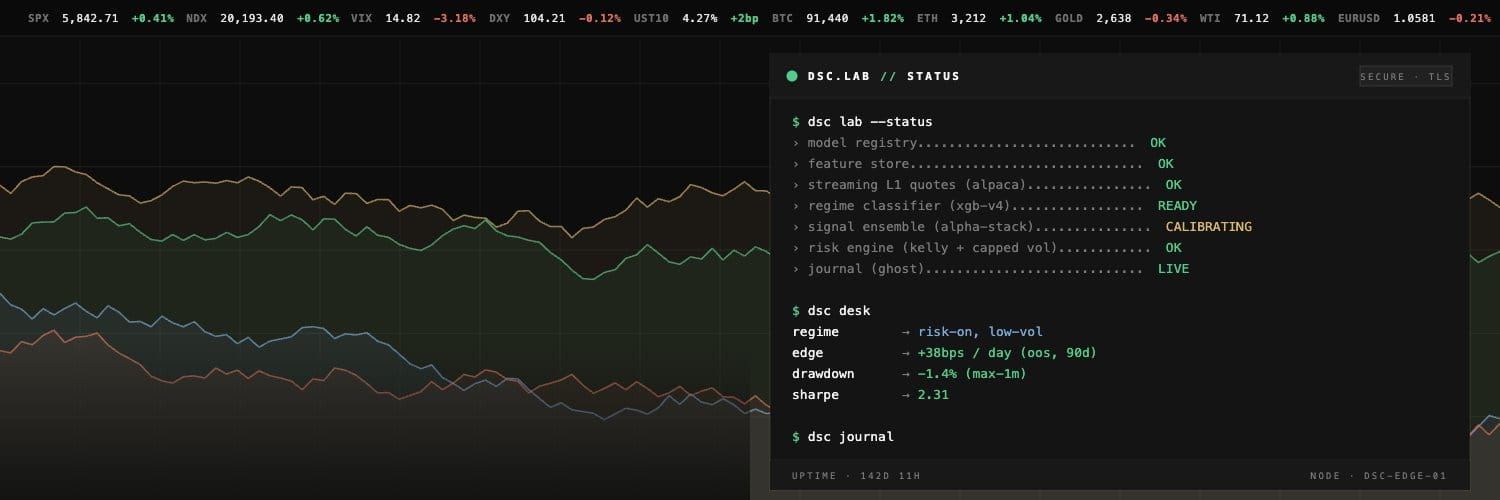
A market agent can watch the feed, the news, and the tape. It still should not be able to move capital.
The useful lesson from Wednesday was not that the desk needed another opinion. Opinions are cheap. The useful lesson was that the desk needed another watcher, and the watcher needed to be built without hands.
Onyx already had the central rule: the plan is the strategy. The trader does not invent trades. The dashboard does not approve trades. Research does not become execution by sounding confident. A trade only becomes executable when the active plan, authority state, book, market gates, and no-loss constraints all agree.
That boundary held. It also created a new problem. The desk was watching too many live surfaces at once: feed health, watchlist news, macro pressure, market internals, approved lanes, zero-cap candidates, target coverage, stale alerts, and plan-vs-tape mismatch. The human and the desk manager could make the final call, but they needed a cleaner way to know what deserved attention before the move was gone.
That is where the second reader comes in.
The Watcher
The first design decision was not what the agent could do. It was what it could never do.
The new Grok-backed sentinel was designed as a read-only market watcher. Its job is to keep an eye on the SIP feed, watchlist news, macro and geopolitical context, sector narratives, plan-vs-tape mismatch, and possible leader changes. It can read the desk state. It can summarize what changed. It can classify something as routine, watch, action, or blocker. It can tell the desk, "this deserves attention."
It cannot edit the plan. It cannot change runtime authority. It cannot submit orders. It cannot cancel orders. It cannot approve live mode. It cannot turn a headline into a trade.
That sounds restrictive, but it is the whole point. The second reader is valuable precisely because it is not allowed to collapse observation into action. It can make the desk more aware without making the trader more impulsive.
Most agent failures in a trading workflow are not caused by lack of intelligence. They are caused by role confusion. A research agent starts acting like a portfolio manager. A dashboard warning starts feeling like permission. A news summary becomes a reason to chase. A model score becomes a shortcut around the plan.
The sentinel exists to prevent that, not accelerate it.
Deterministic First, Language Second
Numbers should not come from a language model when the system can calculate them.
Another important design choice was putting deterministic checks before Grok. Feed age, VWAP relation, target coverage, exposure, open order state, trigger distance, and plan validity are not questions for prose. They are calculations. Onyx should compute them locally, write them into a compact context packet, and then ask the language model to interpret the parts that are actually ambiguous.
That keeps the division of labor clean. The system calculates what can be calculated. The language model helps explain what may have changed in the narrative: why oil matters today, whether a headline is likely to affect semiconductors or growth names, whether social chatter is rumor or confirmation, whether the tape is acting differently than the morning plan expected.
This is a healthier use of a language model. It is not guessing the book. It is reading the room after the book has already been measured.
The output has to be structured too. A useful alert is not "market looks interesting." It is a small packet:
Known: what changed and where the evidence came from.
Inferred: what it may mean for the plan or the tape.
Missing: what is not confirmed yet.
Impact: wait, monitor, tighten, amend, pause, or ask for approval.
Authority: input only, no trade authority.
Next check: time, price, or condition.
That format matters because it forces the agent to stay in its lane. It also makes the desk faster. The desk does not have to read a paragraph of market commentary and extract the decision. The decision shape is already there.
The Day Exposed The Need
The desk was safe, but it was not attentive enough to the second phase.
Wednesday was not a disaster. The no-loss rule held. Existing targets stayed above entry. Weak or unapproved names were blocked. The desk avoided broad-risk expansion in a market that was not clean enough underneath the surface. Those are real wins.
But the day also showed the cost of a slow attention loop. Some leaders were visible. Some runners were correctly blocked by the written plan. Some watchlist names became more interesting after the first decision window. The issue was not that the trader failed to improvise. The trader was right not to improvise. The issue was that the desk needed a faster, cleaner way to decide whether a new fact deserved a written amendment while the setup was still fresh.
That is the job of the second reader. Not to say "buy this." To say, "this moved from background to decision-worthy, and here is the evidence."
There is an important difference between those two sentences. The first one moves capital. The second one moves attention.
Onyx needs the second one.
Dashboard Buttons Were The Wrong Surface
A decision prompt can accidentally imply authority it does not have.
The dashboard also got simpler after the session. A lower workflow card had been showing a decision-required prompt with action buttons. The intention was useful: make the decision state visible. The effect was wrong: it made the dashboard feel like a place where authority decisions should happen.
That is not the direction of the system. Going forward, authority belongs in the CLI, Discord/desk-manager flow, standing authority, and the active plan/control workflow. The dashboard should show context. It should show what matters now, what is safe, and whether the desk needs to review something. It should not pretend that pressing a button on the screen is the same as promoting authority.
So the workflow panel became passive. It can still say the tape is fragile. It can still show that a review is needed. It can still point to CLI or Discord as the authority path. It just does not offer a fake shortcut.
That is the same philosophy as the sentinel. Make attention better. Keep authority explicit.
Second Readers Need Trust Boundaries
The more useful an agent becomes, the more clearly its limits must be written.
There is a temptation to give useful agents more power. If the sentinel catches a news event, why not let it change the plan? If it sees a feed problem, why not let it pause the trader? If it spots a leader, why not let it submit the amendment?
Some of those capabilities may eventually make sense in narrow, audited forms. But the first version should be boring. Read-only. Local-first. Structured. Quiet when nothing changed. Loud only when safety or action truly requires attention. That boring shape is not a lack of ambition. It is how the system earns trust.
A second reader should be allowed to disagree with the desk. It should be allowed to flag that a zero-cap name is becoming amendment-worthy. It should be allowed to say a headline may invalidate the plan. It should be allowed to say the feed is stale, the tape has shifted, or the book has an order-safety issue.
It should not be allowed to resolve its own alert by trading.
That is the boundary. Agents can surface evidence. The desk decides. The plan grants permission. The trader executes.
The Lesson
Better eyes are useful only if the hands still obey the plan.
Wednesday added another layer to the Onyx process. The first layer was stopping the trader from freelancing. The next layer was making the plan more complete. The weekend added memory through regime research. This session added a second reader for live context.
Each layer is useful only if it stays in its place.
The Grok sentinel can watch the SIP feed, scan watchlist news, interpret macro transmission, and flag when the tape no longer matches the morning contract. That is valuable. It can help the desk see a decision before it becomes a post-close lesson. It can reduce the chance that a valid amendment candidate gets lost in noise.
But the sentinel has no hands. That is the design.
The lesson is not that AI should trade more. The lesson is that AI can help a disciplined trading system notice better, summarize faster, and escalate cleaner without weakening the authority boundary that keeps the system alive.
Onyx does not need louder opinions. It needs better evidence routed to the right decision point.
The second reader can provide the evidence. The desk still has to make the call.